Solutions Journalism Series
This story is Part II of a two-part Solutions Journalism series about the Mohican River’s water quality and how local agencies are working to address the issue.
“Who wouldn’t want to come out here, go for a run or walk? It’s so peaceful,” Ashland County Park District Director Eric Schneider said, standing in the middle of a barren field.
The empty farmland was once a fruitful marshy area, and soon it will be again. The park district is expanding Avian Acres Park through a 25-acre wetland restoration project.
“The Avian Acres wetland improvement project represents one of the most ambitious and impactful conservation efforts ever undertaken by the Ashland County Park District,” Schneider said.
Restoring the wetland will enhance water quality, restore natural floodplain function and provide vital habitat for endangered, threatened and migratory species, Schneider said.
A $260,000 grant from the H2Ohio Rivers program is funding the project entirely, with the district planning more recreational improvements to the land pending further grant funding.
But the project represents far more than a local land conservation win: it is one of several projects in a collaborative effort to restore water quality in the Mohican River Watershed.
The wetlands area will be built surrounding Jerome Fork, a tributary of the Mohican River, and its establishment will improve the water’s quality, eventually improving the Mohican River’s water too.


Local agencies work separately toward shared goal of water quality restoration
A 2021 Ohio Environmental Protection Agency survey of Ohio’s 29 major rivers found the Mohican River was the only state river to show a significant decline in water quality.
The Mohican River’s water quality decline comes from an excess of nutrients, largely nitrogen and phosphorus, flowing into the river from upstream water sources.
The Avian Acres wetland establishment will help prevent those nutrients from traveling further south because wetlands act as natural filters, removing nutrients and sediments.
Wetlands naturally slow the flow of water, allowing the nutrients to settle and the soils to absorb them. Then, the abundant aquatic vegetation takes those nutrients from the soil and water to fuel their growth.
Ashland County Parks District is only one of the involved agencies working to improve water quality through wetland restoration.
Clear Fork improvement projects
The Richland County Park District is also transforming 20 acres of agricultural land into wetlands at the Alexander Road crossing of the B&O Trail through an H2Ohio grant.
The wetland work is part of the 96-acre Oxbow Woods park development, which will filter water from streams that eventually flow into the Clear Fork Mohican River.
But the agency did not stop there: the park district is working to acquire land for another wetland restoration: Blooming Grove Wetlands.
“It’s off the beaten path, but I’m pretty excited about this one because it’s focused on water quality improvement. It’s gonna be a good showcase project about why this kind of work is important, wetland restoration work,” RCPD Executive Director Jordan Tackett said.
Phase one of the project involved purchasing 215 acres of land off Bloominggrove Road through a $655,891 H2Ohio Grant. Phase two included more purchases.
The district has now been approved for a $1,764,795 Clean Ohio grant for the third phase of Blooming Grove, which will involve restoring the land to floodplain and riparian wetlands.
“We have a lot of water quality issues around Ohio. Our rivers in Richland County flow right into the Mohican, and we want to aid in the efforts of restoring the water quality,” Tackett said.
West Creek Conservancy, a nonprofit land conservancy serving Northeast Ohio, purchased former Boy Scout camp Camp Avery Hand to transform the property into a nature preserve.
The nonprofit purchased the 110-acre plot for $2.6 million on New Year’s Eve to protect tributaries of Clear Fork that flow through the property, Executive Director Derek Schafer said.
“Clean water is something we can all get behind, I’d hope,” Schafer said.
He works to acquire land for West Creek Conservancy, and he has his eyes on land near the Black Fork Mohican River, which would further improve water quality in the Mohican Watershed.
“There is a lot of energy around conserving water quality. Everyone has something about water that they care about.”
Schafer
“There is a lot of energy around conserving water quality,” Schafer said, “Everyone has something about water that they care about.”
Black Fork improvement project
In September, the Ohio Department of Natural Resources (ODNR) and Western Reserve Land Conservancy completed the Black Fork Forest and Preserve wetland restoration in Mifflin Township.
The project restored 85 acres of wetland and 75 acres of native pollinator and forested habitats. The new wetland buffer is approximately 4,200 linear feet long alongside a stream that flows directly into the Black Fork section of the Mohican River.
Together, these projects aim to reduce overall nutrient levels in the Mohican River, and all water sources downstream of it, by filtering out nutrients before they reach the river.
Mohican River monitoring results several years from now will reveal the efficacy of these projects, but first they must all get off the ground.
As of May 2025, ODNR’s wetland establishment and Water Quality Incentive Program for farmers is reducing 41,308 pounds of phosphorus per year in the Western Lake Erie Basin alone, according to the 2025 H2Ohio annual report.
In addition to their nutrient reduction benefits, wetlands also provide 90 species of threatened or endangered species in Ohio with critical habitat.
H2Ohio plays large role in project development
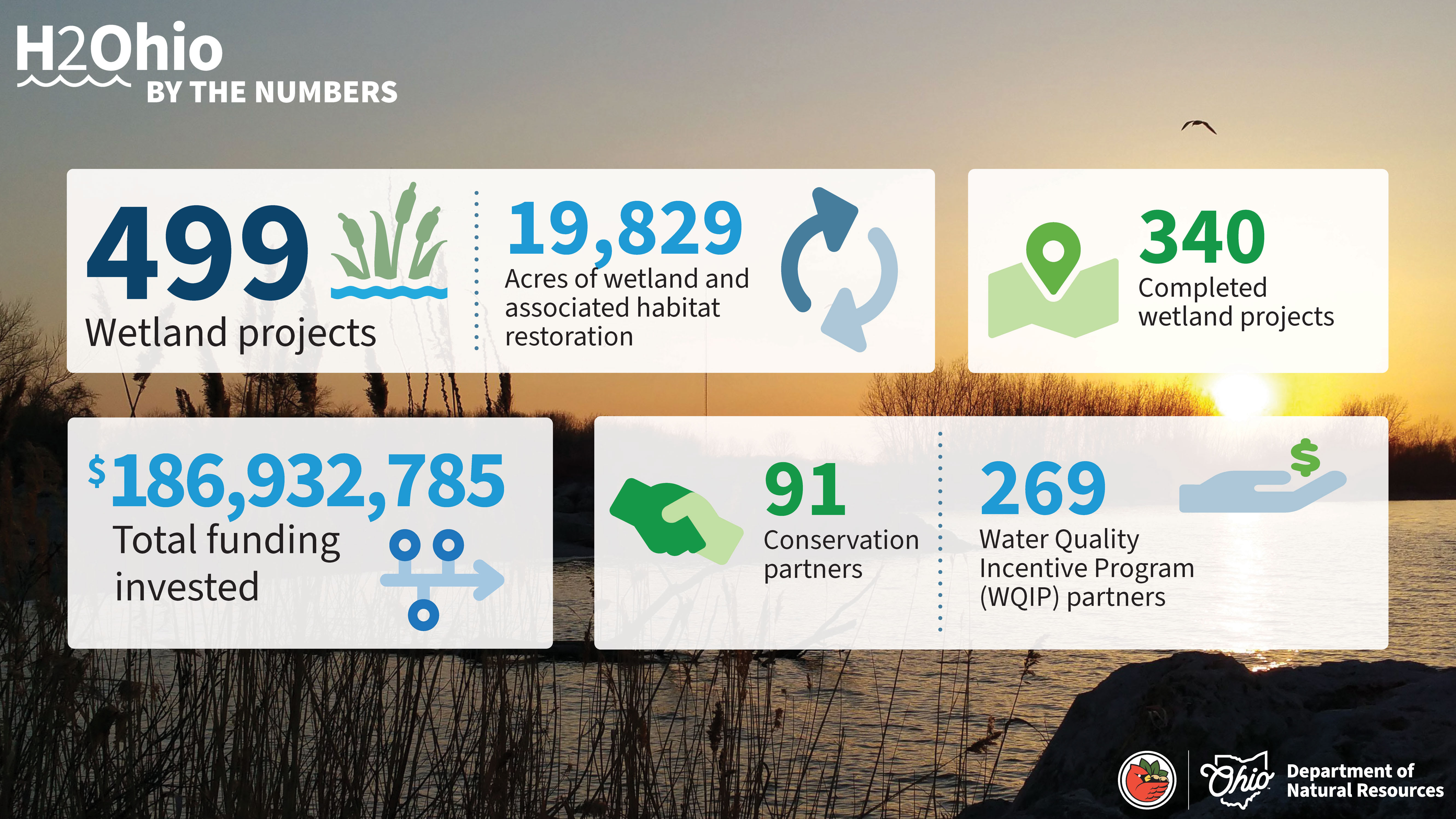
H2Ohio has funded nearly $187 million in water quality improvement projects since Gov. Mike DeWine launched the statewide initiative in 2019.
Those funds have created nearly 20,000 acres of wetland and habitat restoration through 340 completed wetland projects.
H2Ohio is a collaborative effort between state agencies, including ODNR, the Ohio EPA, Ohio Department of Agriculture and Lake Erie Commission, with each agency focusing on different avenues to improve water quality.
ODNR largely focuses on wetland restoration and river cleanups. ODA enrolls farmers in nutrient management programs and OEPA funds water infrastructure improvements.
The funds serve a dual purpose: providing water quality improvement project dollars also funds park expansions, making them more attractive to residents and visitors.
Without the grant funding, the RCPD could not pursue the project on its own because it’s funded through a levy that is dedicated to supporting park maintenance and staffing; there is little left over for major purchases. The same is true for Ashland parks.
“We saw the opportunity through this land acquisition to aid in the efforts of restoring the water quality, and the grant money was available,” Tackett said.
DeWine’s 2026-2027 biennium budget included significant cuts to his H2Ohio initiative, reducing funding to $165 million, down nearly 40% from the $270 million in the previous 2024-2025 budget.
And with DeWine’s term ending in 2027, the future of H2Ohio is uncertain under a new governor.
DeWine said earlier this March he wants to get a bond issue before voters this November to secure long-term funding for H2Ohio.