MOUNT VERNON — Public Assistance Administrator Carla Poland reviewed 2024 data for the public assistance programs Knox County Job & Family Services offers during a March 20 visit with the county commissioners.
Her department oversees several programs:
•SNAP — Supplemental Nutrition Assistance Program
•TANF — Temporary Assistance to Needy Families
•Medicaid
•Back to School
“The systems we use do not always process cases accurately, so it’s essential for caseworkers to have a deep understanding of all the required policies and budgets,” Poland said.
“Some may perceive our caseworkers as just a data entry clerk, but in reality, it’s far more complex than that.”
Training a new worker takes more than a year before the worker completely understands how to process a case.
Poland said Medicaid is the most complex program her department manages.
SNAP
Knox County receives about $11 million in SNAP benefits annually and recoups approximately $1,600 per month from overpayments in SNAP benefits.
Skimming was a problem last year locally and throughout Ohio. To reduce opportunities for fraud, the state is considering using chip cards.
“Right now they’re not replacing any food assistance that’s been skimmed, but only two cases have been reported since we had that,” Poland said.

Knox County schools have a free lunch program and a summer EBT (Electronic Benefits Transfer) SNAP card that assures school-age children that they will receive food assistance during summer.
“You don’t have to be on SNAP benefits to get that EBT card. The requirements are a little different,” Poland said.
The state requires a 95% timeliness rate for processing SNAP applications. Knox County averaged 99% in 2024.
TANF
Thirteen adults and 105 children receive TANF (also known as Ohio Works First) in Knox County. Poland said $682,000 is issued per year.
“The number of TANF/OWF participants has decreased way down over the years,” Poland said. “It used to be we would have like 400 in Knox County. It is now 13.”
Poland said she believes the decrease is due to a limit of 36 months of lifetime eligibility and the state’s requirement to work for benefits.
Ohio minimum wage is $10.70 per hour; federal minimum wage is $7.25 per hour.
An individual working 20 hours a week would make $9.60 an hour, while someone working 35 hours a week would make $5.48 an hour.
“So they’re better off working. You’re going to make more money,” Poland said.
Medicaid
Ohio Medicaid enrollment is just over 3 million. In Knox County, 19.25% of the population (12,075) is enrolled.
Poland said the number enrolled in the 65+ age category (1,089) is interesting.
“What that tells you is those 65 and over have to be really lower income in order to get Medicaid, because they’re also receiving Medicare,” she said.

Knox County JFS pays the Medicare premium for 663 individuals.
The work-age group (19 to 64) totals 2,628 individuals who are not disabled and do not have children.
“If they take any Medicaid away, that’ll probably be the first group that goes because they could work,” Poland said.
Eight-two individuals receive transitional Medicaid. These individuals went to work and made over the income limits for Medicaid.
However, in some circumstances, they can receive Medicaid for six to 12 months during the transition.
Back to school
JFS partners with Interchurch Social Services on this annual campaign, providing school supplies, clothes, shoes, and hygiene products to eligible Knox County children.
Funding comes through TANF. In 2024, JFS spent $220,000 and served 1,425 children.
Poland said JFS hopes to expand the program in 2025 because she turned away about 50 families last year.
Part of that was due to individuals duplicating the vouchers and reusing them.
Poland said JFS took steps to correct that this year and noted the county prosecutor’s office is determining whether to file charges against the individuals.
Call center
Knox County participates in a nine-county call center that handles intake applications, re-determinations, and customer service. Poland said staffing the call center is challenging.
When an individual calls JFS, they will talk with a caseworker from one of the nine counties. However, each county must handle at least as many calls as it originates.
In 2024, Knox County originated 10,382 calls to the call center. It handled 11,500, which means Knox handled the overflow from other counties.
Sandusky and Marion handled less than the number of calls originating in their counties in 2024.
Knox County is typically in the top three in timeliness and volume.
JFS Director Scott Boone said what impresses him about the public assistance department is that the urgency Poland communicates to her team is not about statistics.
“It’s mostly about putting those resources and support mechanisms in the hands of families in our community as soon as possible,” he said.
Legislative action
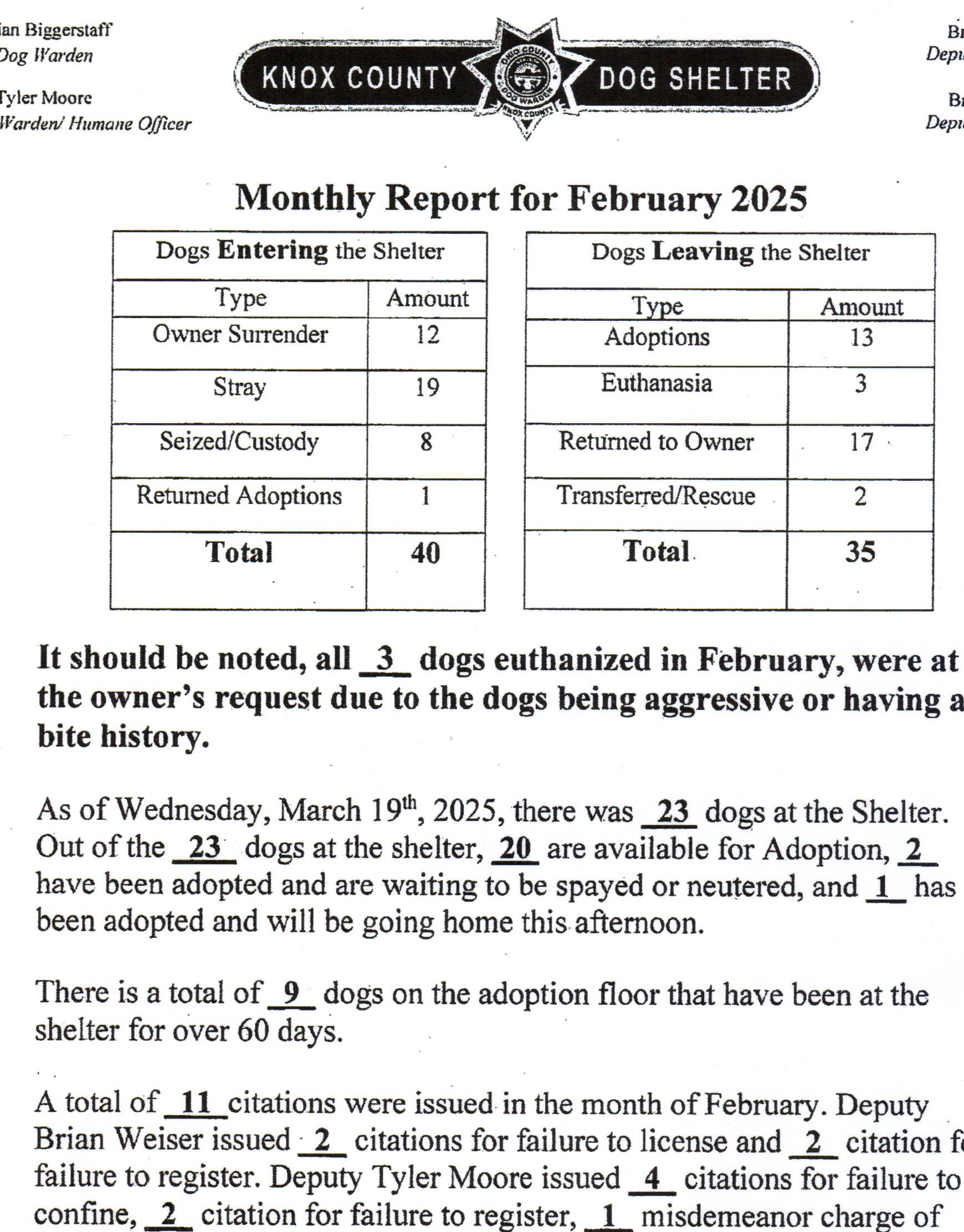
Dog Warden Brian Biggerstaff reported February’s activity at the Knox County Dog Shelter. (Below is his full report.)
The commissioners also took the following legislative actions:
•Approved bid from Running G Farms LLC of $97,929.60 for 2025 roadside mowing
•Authorized Knox County sheriff to dispose of obsolete and surplus radios (donate to West Virginia law enforcement) and vehicle (sell van by sealed bid with proceeds to go into the commissary fund)