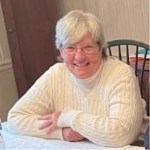
MOUNT VERNON — Over 10,000 military veterans have received a Quilt of Valor. Mount Vernon resident John Wolford received his on his 92nd birthday.
On June 27, Fran Kempton and Debbie Hudepohl presented Wolford with a panel quilt with border designs. Both women helped piece the quilt, and Hudepohl hand-quilted it.
“We picked this one because we knew him personally,” Hudepohl said.
Wolford’s daughter-in-law, LouAnn Wolford, nominated him for the quilt.
A Quilt of Valor is an award. It is not bought or sold, nor is it a gift.
“It is an award earned by you and it is priceless for that reason. As we are stitching, we remember the sacrifices you made for us,” Hudepohl told Wolford.
She recounted the meaning of a Quilt of Valor:
• Quilt top: The many pieces, colors, shapes, and sizes represent the faces of all who serve in the Armed Forces.
• Batting: The batting represents comfort and healing.
• Backing: The quilt back represents the strength of the veterans, their families, and communities united in support.
“This quilt is an expression of gratitude meant to thank and comfort you. We can never know your sacrifice while keeping us safe. This Quilt of Valor says ‘Thank You’ for your service and sacrifice in serving our nation,” Hudepohl said.
“Thank you for allowing us to recognize you,” Kempton added.
When asked what he thought of his surprise birthday gift, Wolford responded with a smile and a quiet, “I think it’s great.”
Seventy-two years ago, on a mountain in Korea, that warmth, comfort, and strength meant the world.
‘I select you’
Born and raised in Knox County, 19-year-old John Raymond Wolford entered the Army on Jan. 11, 1952. He did not volunteer; he was drafted. He refers to the U.S. Army’s recruitment poster but changes the wording to “I select you.”

He trained for eight months at Indian Town Gap, PA, then was sent to California. From there, he went to Japan, where he received his winter gear.
After a two-day stay in Japan, Wolford headed for Korea via ship. The trip took two days.
Arriving in Korea, he boarded a train and, after a day’s journey, reached the base of his mountain. He was 8,500 feet above sea level, a squad leader and rifleman.
A mountain outpost
The Army stationed Wolford on a hill — perhaps Hill 854 — on the mountain. The valley below was the boundary line between the U.S./United Nations and North Korean forces.
To his left was Heartbreak Ridge. To the right, Wolford could see the sea.
“We would watch for enemies,” he said. “We were on one side of the mountain, and we could see them, and they could see you.”
Wolford recalls squads taking turns on night patrol.
“We went down at night along their boundary [in the valley] to make contact with them, but we didn’t make contact,” he said of his turn at patrol. “Someone was patrolling all the time, day or night.”
Wolford arrived at the mountain outpost in September. He spent nine months there, most of the time inside a bunker looking across at a North Korean unit on the other side of the mountain.

“It was horrible. They were slow days. We got shot at by snipers, so you had to keep down,” he explained.
Wolford recalls an occasion when a sniper’s bullet blew up an Army tank. Another memory is of a dead North Korean soldier.
“They never came back and got him. They used napalm, and he burned up,” Wolford said.
“There were a lot of mortar rounds being shot. It lit up everything like a Christmas tree.”
A long, cold winter
The winter of 1952-53 was cold, and it snowed. Wolford and the other servicemen wore heavy, white coveralls to keep warm. The white clothing helped them blend into the snow and camouflauged them from sniper fire.
“We were in our bunker all of the time except when we were on patrol and taking a shower,” Wolford said. “We kept our clothes and shoes on all of the time. You had to be ready to run.
“They tried to bring us a hot meal at lunch time,” he continued. “We ate rations for breakfast and supper.”
Coming home
The military used a point system to determine which soldiers would be discharged first. In the Korean War, soldiers earned four points for each month of close combat. Thirty-six was the magic number.
After spending nine months on the mountain’s front line, Sgt. John Raymond Wolford had earned his 36 points and was ready to come home.

Discharged from the Army at age 21, re-enlisting never entered his mind.
“I never thought about re-enlisting. I got out three months early because there wasn’t anything for me to do,” he said.
He returned to Mount Vernon via Camp Atterbury in Indiana, rented a house, and started working at Cooper Industries.
For two months, he worked at the Mount Vernon Bridge Company and Cooper’s until the unions discovered he was working at both places.
Faced with choosing where to work, Wolford chose Cooper’s and retired from there in 1995. He lives in Mount Vernon and celebrated his 92nd birthday last week with his family.
Wolford was the youngest of six siblings. He has one brother who is still living.
Leroy “Uncle Squeak” Wolford lives in Ontario in Richland County and is a Navy veteran. At 98 years old, Uncle Squeak is among the less than 1% of World War II veterans who are still alive.
Here’s a snippet of his story.
Below are photos from John Wolford’s 92nd birthday party.


Knox Community Hospital proudly supports the vibrant pulse of our community by sponsoring the Life & Culture section on Knox Pages, celebrating the stories and experiences that make our region unique.